When you find a gothic electro-pop album featuring in several end-of-year extreme metal best-ofs for 2017, it comes as no surprise to discover that Ulver are responsible.
Having wrapped up their Norwegian black metal phase some twenty years ago, they may have followed their own map ever since into ambient soundtracks, trip-hop, psychedelia, prog and neo-classical experiments. But as they were there at the beginnings of a genuine musical phenomenon, and since chief creative spirit Kristoffer Rygg still looks like he could holler under a blood-lit moon with the best of them if the mood ever took him that way, Ulver get lifetime genre-membership privileges.
Even though no-one knows which version of the band are going to appear from record to record and it's almost certainly not going to be metal.
To these ears, the Ulver that have turned up for The Assassination Of Julius Caesar really like: Depeche Mode circa Violator; Trevor Horn’s 80’s production work; early 90’s techno; slightly over-earnest songs about the Roman Empire; The Beloved;
The good news is that this foregrounds Rygg’s voice – Ulver’s beautiful, pure-toned trump card – against sympathetic, mostly electronic instrumentation. Assassination is the closest they’ve come to pop since their 2012 psychedelic covers set Childhood’s End, although given that much of their output since then has been freeform jamming this isn’t necessarily saying much.
And granted, the music is still brooding, jagged and lyrically focussed on matters of faith and tragedy. But now Ulver - on, say, closing track Coming Home – are doing their thing over beats not a million miles away from Crockett’s Theme from Miami Vice, which is a big plus in my book. The fussiness I can sometimes resent in their proggier work (I’m looking at you, Wars Of The Roses) is almost completely absent here.
In yr blogger’s opinion, then, Assassination is Ulver’s best, most consistent work since the austere majesty of 2007's Shadows Of The Sun. That’s another synth-heavy album and if you like, Assassination is Shadows down the alternative disco, throwing out shapes at a stately 80’s bpm.
Saturday, January 27, 2018
Wednesday, January 10, 2018
None more brooding: Bective Abbey
Bective Abbey is a wonderful, Romantic (in the poetic sense) ruin in County Meath, Ireland. We made a brief visit there last week as we were staying nearby. Here it is in all its glory on a clear January day.
Saturday, December 30, 2017
Top 10 posts of 2017
It's not been the noisiest year on the blog, but here are the top 10 posts of 2017 by page views.
I've decided to leave out the link round-up posts (the Health-Geekery series, mainly) as they don't involve any proper writing and it seems a little like cheating to include them.
1. Paul, the Liverpool South Parkway Cat
2. Notes from a divided kingdom, Part 1
3. The Fisher King of hitmen is back: John Wick, Chapter 2
4. The versatility of Chim Chim Cheree
5. Sulk: Associates' intense little jewel
6. 8 short notes on the poo emoji cushion
7. Cliff Richard led astray by sorcery!
8. Was pop in crisis in 1976?
9. Wonder Woman: a sense of the superhuman
10. Too good to leave to the critics: Can and I Want More
By category, that's:
Music - 5
Film - 2
Cats - 1
Horror (poo emoji cushions) - 1
Politics - 1
I've decided to leave out the link round-up posts (the Health-Geekery series, mainly) as they don't involve any proper writing and it seems a little like cheating to include them.
1. Paul, the Liverpool South Parkway Cat
2. Notes from a divided kingdom, Part 1
3. The Fisher King of hitmen is back: John Wick, Chapter 2
4. The versatility of Chim Chim Cheree
5. Sulk: Associates' intense little jewel
6. 8 short notes on the poo emoji cushion
7. Cliff Richard led astray by sorcery!
8. Was pop in crisis in 1976?
9. Wonder Woman: a sense of the superhuman
10. Too good to leave to the critics: Can and I Want More
By category, that's:
Music - 5
Film - 2
Cats - 1
Horror (poo emoji cushions) - 1
Politics - 1
Friday, December 29, 2017
Top 5 films of 2017
Top 5 this year
1. Detroit
2. Wonder Woman
3. The Big Sick
4. God's Own Country
5. The Florida Project
Honourable mentions
Baby Driver
Call Me By Your Name
Dunkirk
Guardians Of The Galaxy, Volume 2
Kong: Skull Island
The Lego Batman Movie
Logan
Pitch Perfect 3
Star Wars - The Last Jedi
Their Finest
Thor: Ragnarok
1. Detroit
2. Wonder Woman
3. The Big Sick
4. God's Own Country
5. The Florida Project
Honourable mentions
Baby Driver
Call Me By Your Name
Dunkirk
Guardians Of The Galaxy, Volume 2
Kong: Skull Island
The Lego Batman Movie
Logan
Pitch Perfect 3
Star Wars - The Last Jedi
Their Finest
Thor: Ragnarok
Monday, December 25, 2017
Wednesday, December 20, 2017
A technofix for a democratic problem: on e-voting
THREAD
As i believe all the cool kids are saying.
PS. Here is a link to summary findings from the Electoral Commission's evaluation of 2007 pilot schemes including e-voting. The EC doesn't have a remit to cover the big existential questions like the ones above, but the summary (not written by me, for the record) is still pretty insightful on the issues with the pilots, as well as what would need to happen if Scotland or anyone were determined to give e-voting a credible go.
As i believe all the cool kids are saying.
#Scotland is (sigh) considering introducing electronic voting. Speaking as someone who helped evaluate English #evoting pilots a decade ago, I think it remains a well-intentioned but terrible idea.https://t.co/meiS6RCGVT— Tim Atkinson (@Magpiemoth) December 20, 2017
You can dance around the technical detail (and many have done so) but the first key challenge is informed voter confidence. The geek community in the US and UK e.g. @OpenRightsGroup have been pretty sceptical about real existing #evoting as opposed to some platonic ideal.— Tim Atkinson (@Magpiemoth) December 20, 2017
Without the reasonably well informed giving it the benefit of the doubt, what chance does #evoting have with a public deeply sceptical of politicians and companies' integrity?— Tim Atkinson (@Magpiemoth) December 20, 2017
More fundamentally, it's a techno-fix for a 'democracy problem'. Solving this isn't just about making voting easier (although that's still a good idea), it's about addressing the reasons why people don't vote and improving the number and quality of opportunities to participate.— Tim Atkinson (@Magpiemoth) December 20, 2017
PS. Here is a link to summary findings from the Electoral Commission's evaluation of 2007 pilot schemes including e-voting. The EC doesn't have a remit to cover the big existential questions like the ones above, but the summary (not written by me, for the record) is still pretty insightful on the issues with the pilots, as well as what would need to happen if Scotland or anyone were determined to give e-voting a credible go.
Monday, December 11, 2017
The Golden Age of Post-Modern Roleplaying Pt 1: Introduction and Rifts
Since role-playing is governed more by the Rule of Cool than a sense of appropriate genre boundaries, like computer games it arrived at the post-modern mash-up with more speed and less angst than any number of longer-standing arts.
Without any precedent to guide its creators, the original Dungeons and Dragons, though predominantly swords and sorcery fantasy, was reaching in all directions, bringing in psychics, martial arts and outer-planar horrors to sit alongside the usual warriors and wizards.
But it was only as the hobby grew beyond a single system in the late 70's and 80's, as companies and creators began developing games for every genre - science-fiction, horror, espionage, superheroes et cetera et cetera - that these genre boundaries became more defined and to some extent more policed.
Inevitably, the desire to blur those edges awoke. Certainly by the time I had a few teenage years of ADnD under my belt, in the early 1990's I was hankering for something different, a little less predictable. A bit less level 8 half-elven wizard crawling the dungeon for loot, if you catch my meaning.
And as if it had divined my wishes, the gaming marketplace was rife at that time with with new settings and rules systems which smashed the three dominant types of RPG - fantasy, science-fction, modern - into each other to see what happened.
Here are some examples from this Golden Age of post-modern roleplaying of which I have (mostly) fond memories: Rifts, Shadowrun and Torg.
Rifts - infinite crises on Earth
What Rifts (Palladium Books, originally released 1990) resembled was nothing so much as one of those baroque, overly complicated attempts by Marvel or DC to accomodate their entire sprawling cast of characters and settings in a single crossover event.
The Stan Lee figure in the story of Rifts is Kevin Siembieda, largely responsible for Palladium's series of role-playing games since the early 80's, taking in fantasy (Palladium Fantasy) giant mecha (Robotech), modern horror (Beyond The Supernatural), Teenage Mutant Ninja Turtles and much more besides. And funnily enough, if you put all of this in a post-apocalyptic blender, Rifts is pretty much what you get: the ultimate crossover story for the Palladium metaverse.
The jumping off point for this is - deep breath - a global nuclear war, which causes enough mass death and destruction to send a surge of power through Earth's ley-lines, reawakening its dormant magic and opening portals (them titular rifts) through which pour the scum and flotsam of a thousand universes.
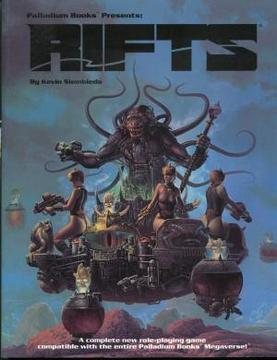
Civilisation as we know it is over: three hundred years later humanity is clawing its way back from the brink amid new friends and foes, ranging from your classic elves/dwarves through power-suited space aliens to horrors from the Great Beyond. The Earth has changed beyond recognition - Atlantis, for example, returns as an interdimensional entrepôt, slave station and purveyor of regrettable fanservice (check the spectacular but somewhat creepy original cover of the main rulebook for an example).
"Hans, are we the baddies?"
Rifts also took the interesting decision of having the surviving major human states be mainly authoritarian regimes and fascist dictatorships deeply hostile to aliens and magic. This is particularly pronounced in the US/Canadian Coalition States, whose military literally walk round in (lovingly illustrated) death's head uniforms. On special occasions, these thanatoic Nazi fanboys ride a freaking skull-walker on legs. Subtle, they are not.
While the players could play characters from the Coalition military, the setting steered them towards a 'Hans - are we the baddies?' moment where they reject their indoctrination and go AWOL. Alternatively, you could start as a crew of independents and renegades already aligned with friendly non-humans, pursuing a third way between 'Mega City One without the jokes' on the one hand and 'in hock to tentacled demi-gods' on the other.
The Coalition States were only one of several great flourishes of original material that made Rifts potentially hugely interesting to play. The sourcebook for the Vampire Kingdoms of Mexico was another, hands down some of the best written, most thoughtful gaming fuel I've ever come across.
Two cheers for the post-modern druids
Despite the global settings and the Japanese influences in the work, there was something essentially American about Rifts. Beyond the post-apocalyptic Western vibes on its home continent, its reliance on the rule of cool and a certain amount of cultural cliche meant the good stuff went hand-in-hand with the embarassing. The sourcebook for England, for example, put out some intriguing ideas about post-modern druids in the service of giant sentient Millenium Trees, only to spoil it with an kitschy interpretation of Arthurian myth.
There was a fondness too, for page after page of lovingly drawn guns, armour and vehicles, far beyond what the system actually needed. This was a bit of a left-hand/right-hand problem given the effort the game put into critiquing the military-industrial complex, but it also filled up space that could have been spent on scenarios and usable NPCs.
And then there's the rules system. Granted, in the intervening 25 years Palladium may have ironed out some of the bugs, but if you've ever played one of their games you probably know what I'm talking about. It was a shotgun wedding of percentile and d20 mechanics for stats, skills and combat manoeuvres that didn't quite fit together, but more or less managed to be playable with some fudging from the GM.
Now, I don't mind that, because I've never met a rules system I couldn't happily ignore in favour of the story or at least bend until it breaks, but if you like a coherent, holistically designed system, Rifts was not your huckleberry.
Get me that bigger fish
What was finally likely to tip a rules purist over the edge was the sheer power imbalance between starting characters, as well as between those characters and typical NPCs. With cyborgs, warriors in mini-mecha suits, steroid abusers and young dragons to choose from as character or racial classes, pity the player with a wilderness scout or (ahem) 'rogue scholar' who had to mix it up with them.
But Rifts NPCs had it still worse. Thanks to the system distinguishing betwen normal damage and 'mega damage' even a relatively weak player character with an energy pistol could destroy an unarmoured human with a single shot. Without some careful handling by the GM, Rifts created a world where no-one would risk taking their helmet off for fear of a called shot to the head, where violence was always the solution and where the only solution to rampaging player characters was to summon a bigger fish to keep them a line.
Palladium had sourcebooks full of bigger fish (those tentacled demi-gods again) but for me that's a symptom of the problem, not the cure.
Cosmic ambition
In spite of all of this, it's worth honouring the sheer cosmic ambition of Siembieda and his collaborators and their aspiration towards creating something bigger, more syncretic and certainly more wildly eclectic than had previously been attempted in a role-playing game.
And Rifts is still going strong today with an updated edition available from Palladium. If you know the rules system will be a deal-breaker for you, you may also be interested to know it's been developed as a setting for Savage Worlds. Certainly I'm considering picking it up.
[to be continued with a look at Torg and Shadowrun]
Without any precedent to guide its creators, the original Dungeons and Dragons, though predominantly swords and sorcery fantasy, was reaching in all directions, bringing in psychics, martial arts and outer-planar horrors to sit alongside the usual warriors and wizards.
But it was only as the hobby grew beyond a single system in the late 70's and 80's, as companies and creators began developing games for every genre - science-fiction, horror, espionage, superheroes et cetera et cetera - that these genre boundaries became more defined and to some extent more policed.
Inevitably, the desire to blur those edges awoke. Certainly by the time I had a few teenage years of ADnD under my belt, in the early 1990's I was hankering for something different, a little less predictable. A bit less level 8 half-elven wizard crawling the dungeon for loot, if you catch my meaning.
And as if it had divined my wishes, the gaming marketplace was rife at that time with with new settings and rules systems which smashed the three dominant types of RPG - fantasy, science-fction, modern - into each other to see what happened.
Here are some examples from this Golden Age of post-modern roleplaying of which I have (mostly) fond memories: Rifts, Shadowrun and Torg.
Rifts - infinite crises on Earth
What Rifts (Palladium Books, originally released 1990) resembled was nothing so much as one of those baroque, overly complicated attempts by Marvel or DC to accomodate their entire sprawling cast of characters and settings in a single crossover event.
The Stan Lee figure in the story of Rifts is Kevin Siembieda, largely responsible for Palladium's series of role-playing games since the early 80's, taking in fantasy (Palladium Fantasy) giant mecha (Robotech), modern horror (Beyond The Supernatural), Teenage Mutant Ninja Turtles and much more besides. And funnily enough, if you put all of this in a post-apocalyptic blender, Rifts is pretty much what you get: the ultimate crossover story for the Palladium metaverse.
The jumping off point for this is - deep breath - a global nuclear war, which causes enough mass death and destruction to send a surge of power through Earth's ley-lines, reawakening its dormant magic and opening portals (them titular rifts) through which pour the scum and flotsam of a thousand universes.
Civilisation as we know it is over: three hundred years later humanity is clawing its way back from the brink amid new friends and foes, ranging from your classic elves/dwarves through power-suited space aliens to horrors from the Great Beyond. The Earth has changed beyond recognition - Atlantis, for example, returns as an interdimensional entrepôt, slave station and purveyor of regrettable fanservice (check the spectacular but somewhat creepy original cover of the main rulebook for an example).
"Hans, are we the baddies?"
Rifts also took the interesting decision of having the surviving major human states be mainly authoritarian regimes and fascist dictatorships deeply hostile to aliens and magic. This is particularly pronounced in the US/Canadian Coalition States, whose military literally walk round in (lovingly illustrated) death's head uniforms. On special occasions, these thanatoic Nazi fanboys ride a freaking skull-walker on legs. Subtle, they are not.
While the players could play characters from the Coalition military, the setting steered them towards a 'Hans - are we the baddies?' moment where they reject their indoctrination and go AWOL. Alternatively, you could start as a crew of independents and renegades already aligned with friendly non-humans, pursuing a third way between 'Mega City One without the jokes' on the one hand and 'in hock to tentacled demi-gods' on the other.
The Coalition States were only one of several great flourishes of original material that made Rifts potentially hugely interesting to play. The sourcebook for the Vampire Kingdoms of Mexico was another, hands down some of the best written, most thoughtful gaming fuel I've ever come across.
Two cheers for the post-modern druids
Despite the global settings and the Japanese influences in the work, there was something essentially American about Rifts. Beyond the post-apocalyptic Western vibes on its home continent, its reliance on the rule of cool and a certain amount of cultural cliche meant the good stuff went hand-in-hand with the embarassing. The sourcebook for England, for example, put out some intriguing ideas about post-modern druids in the service of giant sentient Millenium Trees, only to spoil it with an kitschy interpretation of Arthurian myth.
There was a fondness too, for page after page of lovingly drawn guns, armour and vehicles, far beyond what the system actually needed. This was a bit of a left-hand/right-hand problem given the effort the game put into critiquing the military-industrial complex, but it also filled up space that could have been spent on scenarios and usable NPCs.
And then there's the rules system. Granted, in the intervening 25 years Palladium may have ironed out some of the bugs, but if you've ever played one of their games you probably know what I'm talking about. It was a shotgun wedding of percentile and d20 mechanics for stats, skills and combat manoeuvres that didn't quite fit together, but more or less managed to be playable with some fudging from the GM.
Now, I don't mind that, because I've never met a rules system I couldn't happily ignore in favour of the story or at least bend until it breaks, but if you like a coherent, holistically designed system, Rifts was not your huckleberry.
Get me that bigger fish
What was finally likely to tip a rules purist over the edge was the sheer power imbalance between starting characters, as well as between those characters and typical NPCs. With cyborgs, warriors in mini-mecha suits, steroid abusers and young dragons to choose from as character or racial classes, pity the player with a wilderness scout or (ahem) 'rogue scholar' who had to mix it up with them.
But Rifts NPCs had it still worse. Thanks to the system distinguishing betwen normal damage and 'mega damage' even a relatively weak player character with an energy pistol could destroy an unarmoured human with a single shot. Without some careful handling by the GM, Rifts created a world where no-one would risk taking their helmet off for fear of a called shot to the head, where violence was always the solution and where the only solution to rampaging player characters was to summon a bigger fish to keep them a line.
Palladium had sourcebooks full of bigger fish (those tentacled demi-gods again) but for me that's a symptom of the problem, not the cure.
Cosmic ambition
In spite of all of this, it's worth honouring the sheer cosmic ambition of Siembieda and his collaborators and their aspiration towards creating something bigger, more syncretic and certainly more wildly eclectic than had previously been attempted in a role-playing game.
And Rifts is still going strong today with an updated edition available from Palladium. If you know the rules system will be a deal-breaker for you, you may also be interested to know it's been developed as a setting for Savage Worlds. Certainly I'm considering picking it up.
[to be continued with a look at Torg and Shadowrun]
Subscribe to:
Posts (Atom)