Gangs of obsolete technologies huddle on street corners, radiating greyscale menace.
Barnt Green Lantern
Black Country Widow (or Canary)
Clint Barton-under-Needwood (aka the Staffordshire Hawkeye)
Ironbridge Man
The Redditch Tornado
Scarlet Wychavon
Solihulk
Star City Man (or indeed Lord)
Wolvo-rine
Alright, let's go high concept.
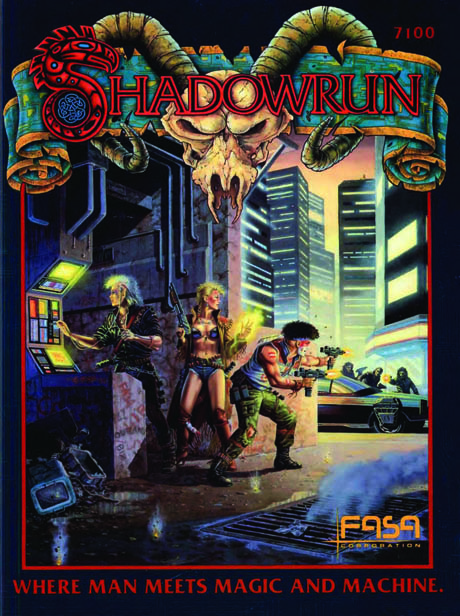
Because what separates Shadowrun (online home here) from the genre collages of Rifts and Torg is that it tries, and to be fair mostly succeeds, in explaining why elves, dwarves and orcs should be runnng round the back streets of Seattle looking like members of The Sigue Sigue Sputnik Fan Club.
To understand Shadowrun you have to know how big a deal cyberpunk was in the late 80's. Influences from fiction (Neuromancer et al), film and music had combined to create an aesthetic and a set of tropes that were very marketable.
Gunmetal bionic limbs! Mirrorshades! Cyberspace! Defy the corporate system in tight leather trousers! Hairspray!
Ahem. You get the picture.
What pure cyberpunk role-playing games foundered on, in your correspondents opinion, was translating the moral ambiguity of the genre into a satisfying gaming experience. Usually - at least if you were a teenager who had cut your teeth on DnD and Games Workshop, any complexity tended to be discarded in favour of those cool cybernetic implants and those outsize guns in a nihilist race to the bottom.
By combining fantasy and cyberpunk - the old favourite and the flavour of the month - Shadowrun gave itself more options. Rather than banging your head repeatedly against the nightmare of dystopian capitalism, it opened the door to myth, magic and the possibility of hope.
And nothing demonstrates that more clearly than the narrative of how enchantment returns to the moderm world, with the indigenous peoples of the Americas regaining the use of their traditional magics to reclaim much of the continent east of the Mississippi.
(as I recall, it's pretty well done for its time and a tribute to the never knowingly under-backstoried original creators at FASA, a company who lavished such love on the Battletech universe - a game essentially about giant mecha firing rockets at each other - that I can still remember whole star systems-worth of it today.)
Shadowrun says another world is possible. Which is most decidedly not a cyberpunk sentiment.
One can see how the genre-blending understandably irritated William Gibson and wouldn't work half as well in a literary context. But it goes to show a) that books and role-playing games are different media with different needs and in particular that b) role-playing narratives often benefit from being anti-hegemonic in a way which fiction simply doesn't need to be.
A quick round-up of the best books I've read so far this year.
At The Existentialist Cafe: Freedom, Being, and Apricot Cocktails - Sarah Bakewell
The Honours - Tim Clare
Walkaway - Cory Doctorow
Normal - Warren Ellis
Winter's Tide - Ruthanna Emrys
Raven Stratagem - Yoon Ha Lee
The Will To Battle - Ada Palmer
Aurora - Kim Stanley Robinson (review here)
Osama - Lavie Tidhar
A Night In The Lonesome October - Roger Zelazny
All genre fiction, except for Sarah Bakewell's overview of existentialism. And all very good, although not quite great enough to merit bold type. :)
Found art: author unknown but fond of Eiffel 65.