Monday, May 21, 2012

Dark Shadows mini-review

If anyone's earned the right to pastiche Tim Burton, it's probably Tim Burton. And Dark Shadows is good fun - playful, sparky dialogue, atmospherically shot and with a good-if-not-great cast.

But it does feel a bit like Burton doing 'one for the studio'. What you'd expect from one of his films - Depp, Bonham Carter, families, monsters, families of monsters, Gothic camp - are all there in a slightly too predictable fashion. And the film has an episodic structure - a legacy of its TV show origins? - which moves the film on too quickly from one plot point to the next to give it intelligence or emotional heft. 

As my companion remarked, it would have worked much better as a mini-series, giving it room to breathe.

Tuesday, May 15, 2012

Cream tea, Nick Berry and anomie on the Yorkshire Moors


It was as if I'd stepped into a pageant of the rural past when we left the car park at Goathland. There were Morris dancers on the village green and a Ford Anglia parked outside the souvenir shop. The tea-room played second-string sixties hits. Steam trains ran on the railway line thronged by spotters and snappers.


History was repeating itself as the worst possible kind of kitsch.

Goathland is also well on its way to becoming Aidenfield, home of TV retro-fest Heartbeat, which is mainly filmed there. Every shop is full of souvenirs and the pub proclaims its dual identity as the Aidenfield Arms. Nick Berry's face stares out of tea-towels in windows like a benign Big Brother. 

 
Why does a village deny its own identity to become a living fiction? The obvious answer here is money. There are plenty of pretty (if austere) villages in the moors like Goathland, but Aidenfield is its unique selling point. And the absence of any actual services and shops for the residents underlines the point that this is less a functioning community, more a rural tourism retail centre.

It suits Goathland to sink beneath its fictional alter ego.

So what? What does it matter if indulging ourselves in an imaginary Sixties provides a momentary distraction for middle-class tourists and a living in a hard-pressed Moors village?

Channeling my outer hard-headed economist (I've not managed to locate an inner economist, but count several among my good friends), I'd suggest the Aidenfielding of the countryside is a false solution to a viable rural society. If we're serious about jobs, about food security, about villages that work as places of local commerce and community, then we have to offer more than cream teas and Heartbeat paraphenalia, even if there's no dishonour in the tourist trade.

On a more personal note, I also find something distubing about the senility of cultural memory on display in Goathland/Aidenfield, itself a debased version of the slick sixties nostalgia peddled by Heartbeat. In Heartbeatland, we can gloss over the social conflict and politics of the period, never mind the present, and return to an imagined era when everyone knew their place. When threat, change or conflict is resolved or reconciled with the whole by the end of each episode. Where everyone is white – I saw not a single exception in my visit, and the souvenir shop sold gollywogs. 


Yep. Gollywogs. There are no words...

And what does it say about us that we're seduced by this imagined village? Nostalgia has always been with us, but it needs to be offset by a vision of the future, a prospect of hope, in order for us be psycho-culturally viable and equal to the challenges of the present. I bear Goathland no ill will, but as a microcosm of the way we live now, it feels like part of the problem rather than part of the solution.

Monday, April 30, 2012

The Crosby, Stills, Nash & Young of superheroes - Avengers Assemble


Marvel Studios have finally delivered a film with a decent script, a reasonably coherent plot, some decent performances and a proper sense of spectacle. True, it did take them five atttempts to manage all of these at once. But we've set the controls for praise not burial, so let's continue in this vein.

It's safe to assume the 200% increase in genuinely funny one-liners compared to the previous films is due to the presence of Joss Whedon at the controls. RDJ and Mark Ruffalo (taking over the Bruce Banner role from Edward Norton) are well served by this film (or vice versa). For diffferent reasons, so is Scarlett Johanssen (Black Widow), supplying Whedon's deep-seated need to have a badass female martial artist in anything he does. Ever.

Neither Chris Hemsworth or Chris Evans have to carry the film and are much the better for it. Tom Hiddleston continues his evil Withnail schtick as Loki to good effect (We must have some booze! We demand to have some booze! And the total subjugation of humanity!). Samuel L Jackson is entertainingly hammy, but can someone give him a decent screen role again?

The aliens were from H R Giger via Michael Bay, and the battle for New York was – even for someone like me who prefers his action slow motion and stylised rather than a whirlwind of CGI chaos – was very well done.

I was grateful that Avengers Assemble was not yet another origin story, nor was it crushed by the need to explore a metaphor with mind-numbing literality. Instead, it could concentrate on its core business of smart-ass remarks and diorama-drama and was all the better for it.

Wednesday, April 25, 2012

Letter of the week: Formula One good for Bahrain protests!

Today's Metro correspondent wants to have their cake and eat it, executing some logical loop-de-loops to suggest that the Grand Prix going ahead was in fact good for Bahraini protesters


As a bonus, here's a further Metro reader writing in from somewhere in the mid nineteenth century to suggest a return to an all-hereditary House of Lords. Props for the swipe at vegetarians, and stay classy Mr/Ms Noblesse Oblige!

Sunday, April 22, 2012

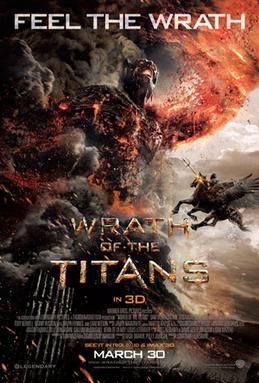
Titan Status: Wrathful.

It was a moment of weakness, I swear! It was a rainy Sunday in Cannock, I'd already seen The Pirates! In an adventure with Scientists! and I thought, why not?

And so the road to Hades is paved with good intentions.


Wrath Of The Titans is pretty mediocre, though it doesn't have enough personality to be a truly terrible film. So, I'm going to restrict myself to a point about story vs spectacle

The film has one of the richest veins of metaphor and story in European culture as its inspiration. And squanders it in myth-mix 'n' match - here a cyclops, there a chimera - which makes for 'Dude it's...' recognition but no mystery, no reach for the epic. 

Indeed, Wrath's idea of epic is sacrificing script, characterization and a sense of wonder for its true Gods - sh*t blowing up and CGIdolatry. But the size of the spectacle does not equate to the amount of excitement caused. 

For example, the drive to Armageddon to action films is made unusually literal in Wrath by the climactic battle to prevent ambulant volcano and part-time Barry White impersonator Cronos from destroying the world. Flames rain down! Four handed monsters run amok! Winged horses! And it's boring. 

To take an extreme counter-example, Godzilla created more thrills using only a man in a rubber dinosaur costume, a Tokyo diorama and some poor lighting.

And the cast! Sam Worthington at least gets quality screen time. But why throw Rosamund Pike, Ralph Fiennes and Liam Neeson at a film - the latter two in rent-a-gravitas roles as a goateed Hades and hirsute Zeus - if you're not going to give them any decent lines? They are beards - designed to divert the attention away from the fact that Wrath is uninterested in words, character or even people at all.

 At this rate, I'll start to think that Volcano Boy Cronos is actually the most sympathetic character in Wrath, so before I do let's consider three small not-quite saving graces.

One, there are two a few decent set-pieces in search of a better film: a constantly moving labyrinth which serves as a secret passage to Tartarus is fun and well-animated. And a woodland battle with Cyclopses, [my precious] and giant log traps manages to evoke the spirit of Ray Harryhausen and the ewoks at the same time.

Second, Bill Nighy, channeling Tim The Enchanter from the Holy Grail to cameo as Hephaestus, and treating Wrath with exactly the respect it deserves. 

Finally, I shall never think of Ares again except as a particularly obnoxious professional wrestler.

PS - if you've made it this far, a bonus bit of particularly pedantic grammatical geekery. The film should be called Wrath of the Titan singular, since there is only one titan in the film - Cronos. Everyone else is either a god, a demigod, a monster or just plain human. 

Should I be more proud or more ashamed of myself for spotting that?

Friday, April 20, 2012

Early Tanith Lee reviewed: like Anais Nin ghosting Robert E Howard

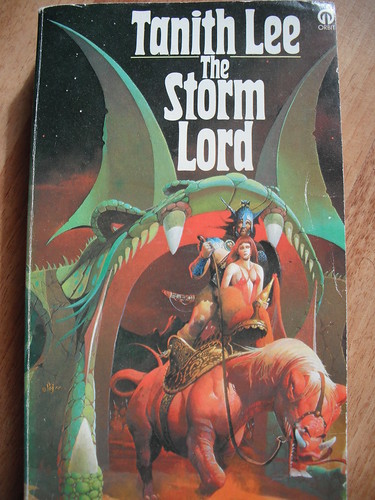
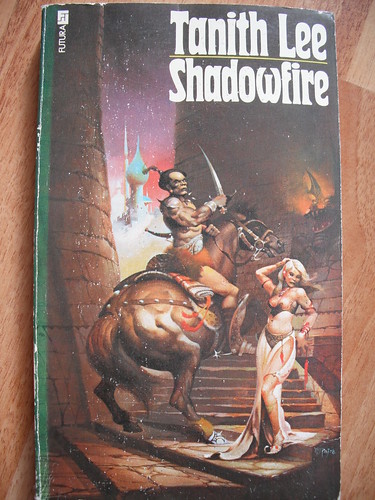
I've suggested here before that the hallmark of a good - truly memorable - fantasy story is  that you don't know how you feel about it. As further tokens of fantasy's power to unsettle, I offer these two Tanith Lee early seventies swords 'n' sex 'n' sorcery specials: The Storm Lord and Shadowfire.

And check out these covers! While the art raises questions - chiefly WTF leotard? in the case of The Storm Lord - it does capture the phantasmagorical nature of the contents.

Oh, Tanith Lee! Part 2

Oh, Tanith Lee! Part 1

At least at this early stage in her career, Lee comes on like Anais Nin ghosting Robert E Howard - pecs and princesses pulp fiction with its latent surrealism unfettered. She takes us through stunning descriptive set-pieces - a ship caught by a chain of erupting volcanoes, a gigantic, grave-robbed statue of a snake mother-goddess in a secret cavern, an underground road built by long-dead immortals - which seem more like Freudian dream-work than Tolkien-style landscape porn.

The dead-eyed amorality of her noble savages and decadents, again, amplifies the strangeness. There's little glorification of her muscular protagonists here, each sows the seeds of their own ruin. And while the rapture of the physical remains - there's a lot of sex and some troubling despite-strong-feminist-overtones consent issues which again remind me a bit of Nin - it's free from the sniggering schoolboy behind the male authorial gaze.

This is wierd fiction which defies easy qualification. And there's something in that inability to reduce either The Storm Lord or Shadowfire to their constituent parts which makes both of them worthy of note.