Barnt Green Lantern
Black Country Widow (or Canary)
Clint Barton-under-Needwood (aka the Staffordshire Hawkeye)
Ironbridge Man
The Redditch Tornado
Scarlet Wychavon
Solihulk
Star City Man (or indeed Lord)
Wolvo-rine
Saturday, August 4, 2018

Thursday, July 19, 2018
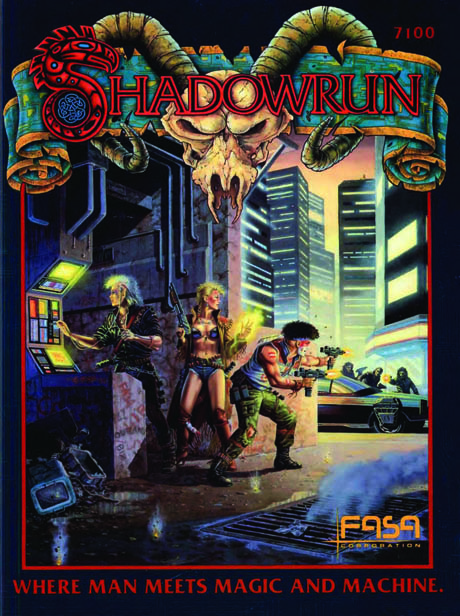
The golden age of post-modern role-playing 3 - Shadowrun
Alright, let's go high concept.
Because what separates Shadowrun (online home here) from the genre collages of Rifts and Torg is that it tries, and to be fair mostly succeeds, in explaining why elves, dwarves and orcs should be runnng round the back streets of Seattle looking like members of The Sigue Sigue Sputnik Fan Club.
To understand Shadowrun you have to know how big a deal cyberpunk was in the late 80's. Influences from fiction (Neuromancer et al), film and music had combined to create an aesthetic and a set of tropes that were very marketable.
Gunmetal bionic limbs! Mirrorshades! Cyberspace! Defy the corporate system in tight leather trousers! Hairspray!
Ahem. You get the picture.
What pure cyberpunk role-playing games foundered on, in your correspondents opinion, was translating the moral ambiguity of the genre into a satisfying gaming experience. Usually - at least if you were a teenager who had cut your teeth on DnD and Games Workshop, any complexity tended to be discarded in favour of those cool cybernetic implants and those outsize guns in a nihilist race to the bottom.
By combining fantasy and cyberpunk - the old favourite and the flavour of the month - Shadowrun gave itself more options. Rather than banging your head repeatedly against the nightmare of dystopian capitalism, it opened the door to myth, magic and the possibility of hope.
And nothing demonstrates that more clearly than the narrative of how enchantment returns to the moderm world, with the indigenous peoples of the Americas regaining the use of their traditional magics to reclaim much of the continent east of the Mississippi.
(as I recall, it's pretty well done for its time and a tribute to the never knowingly under-backstoried original creators at FASA, a company who lavished such love on the Battletech universe - a game essentially about giant mecha firing rockets at each other - that I can still remember whole star systems-worth of it today.)
Shadowrun says another world is possible. Which is most decidedly not a cyberpunk sentiment.
One can see how the genre-blending understandably irritated William Gibson and wouldn't work half as well in a literary context. But it goes to show a) that books and role-playing games are different media with different needs and in particular that b) role-playing narratives often benefit from being anti-hegemonic in a way which fiction simply doesn't need to be.
Because what separates Shadowrun (online home here) from the genre collages of Rifts and Torg is that it tries, and to be fair mostly succeeds, in explaining why elves, dwarves and orcs should be runnng round the back streets of Seattle looking like members of The Sigue Sigue Sputnik Fan Club.
To understand Shadowrun you have to know how big a deal cyberpunk was in the late 80's. Influences from fiction (Neuromancer et al), film and music had combined to create an aesthetic and a set of tropes that were very marketable.
Gunmetal bionic limbs! Mirrorshades! Cyberspace! Defy the corporate system in tight leather trousers! Hairspray!
Ahem. You get the picture.
What pure cyberpunk role-playing games foundered on, in your correspondents opinion, was translating the moral ambiguity of the genre into a satisfying gaming experience. Usually - at least if you were a teenager who had cut your teeth on DnD and Games Workshop, any complexity tended to be discarded in favour of those cool cybernetic implants and those outsize guns in a nihilist race to the bottom.
By combining fantasy and cyberpunk - the old favourite and the flavour of the month - Shadowrun gave itself more options. Rather than banging your head repeatedly against the nightmare of dystopian capitalism, it opened the door to myth, magic and the possibility of hope.
And nothing demonstrates that more clearly than the narrative of how enchantment returns to the moderm world, with the indigenous peoples of the Americas regaining the use of their traditional magics to reclaim much of the continent east of the Mississippi.
(as I recall, it's pretty well done for its time and a tribute to the never knowingly under-backstoried original creators at FASA, a company who lavished such love on the Battletech universe - a game essentially about giant mecha firing rockets at each other - that I can still remember whole star systems-worth of it today.)
Shadowrun says another world is possible. Which is most decidedly not a cyberpunk sentiment.
One can see how the genre-blending understandably irritated William Gibson and wouldn't work half as well in a literary context. But it goes to show a) that books and role-playing games are different media with different needs and in particular that b) role-playing narratives often benefit from being anti-hegemonic in a way which fiction simply doesn't need to be.
Monday, June 11, 2018
Link library: compassionate communities
Thinking of narratives for volunteer recruitment, I wonder how useful the concept of compassionate communities will be?
- Dying Matters: why we should develop compassionate communities?
- Compassionate communities: end-of-life care as everyone’s responsibility - article in QJM by the originator of compassionate communities, Professor Allan Kellehear
- Ambitions for Palliative and End of Life Care: A national framework for local action 2015-2020, by the National Palliative and End of Life Care Partnership of which the MND Association is a member. See in particular chapter 6 which is all about volunteers
- Blog post on Marie Curie about Prof Kellehear's ideas and its implications for their work.
Update: a couple of new links courtesy of Sue Muller
- Compassionate Inverclyde launches
- Bill's story - video explaning compassionate communities from Palliverse
Update The Second: similar issues from a slightly different angle - as a joint group of government officials and voluntary, community and social enterprise reps put forward an action plan for involving the sector in improving health, well-being and social care outcomes.
See the VSCE Review website for more information.
- Dying Matters: why we should develop compassionate communities?
- Compassionate communities: end-of-life care as everyone’s responsibility - article in QJM by the originator of compassionate communities, Professor Allan Kellehear
- Ambitions for Palliative and End of Life Care: A national framework for local action 2015-2020, by the National Palliative and End of Life Care Partnership of which the MND Association is a member. See in particular chapter 6 which is all about volunteers
- Blog post on Marie Curie about Prof Kellehear's ideas and its implications for their work.
Update: a couple of new links courtesy of Sue Muller
- Compassionate Inverclyde launches
- Bill's story - video explaning compassionate communities from Palliverse
Update The Second: similar issues from a slightly different angle - as a joint group of government officials and voluntary, community and social enterprise reps put forward an action plan for involving the sector in improving health, well-being and social care outcomes.
See the VSCE Review website for more information.
Saturday, June 9, 2018
Reading recommendations from 2018 so far
A quick round-up of the best books I've read so far this year.
At The Existentialist Cafe: Freedom, Being, and Apricot Cocktails - Sarah Bakewell
The Honours - Tim Clare
Walkaway - Cory Doctorow
Normal - Warren Ellis
Winter's Tide - Ruthanna Emrys
Raven Stratagem - Yoon Ha Lee
The Will To Battle - Ada Palmer
Aurora - Kim Stanley Robinson (review here)
Osama - Lavie Tidhar
A Night In The Lonesome October - Roger Zelazny
All genre fiction, except for Sarah Bakewell's overview of existentialism. And all very good, although not quite great enough to merit bold type. :)
At The Existentialist Cafe: Freedom, Being, and Apricot Cocktails - Sarah Bakewell
The Honours - Tim Clare
Walkaway - Cory Doctorow
Normal - Warren Ellis
Winter's Tide - Ruthanna Emrys
Raven Stratagem - Yoon Ha Lee
The Will To Battle - Ada Palmer
Aurora - Kim Stanley Robinson (review here)
Osama - Lavie Tidhar
A Night In The Lonesome October - Roger Zelazny
All genre fiction, except for Sarah Bakewell's overview of existentialism. And all very good, although not quite great enough to merit bold type. :)
Friday, June 8, 2018

Useful charity links 8 June
Why self-care and collective well-being are crucial to winning change (MobLab)
City of Dreams: report from a Brazilian climate change campaign mobilising popular input and support (MobLab)
Hardy Merriman offers a useful theoretical model for defining a movement (International Centre on Nonviolent Conflict)
A blueprint for distributed organising (MobLab)
Free download report from Outrageous Impact on charity innovation
City of Dreams: report from a Brazilian climate change campaign mobilising popular input and support (MobLab)
Hardy Merriman offers a useful theoretical model for defining a movement (International Centre on Nonviolent Conflict)
A blueprint for distributed organising (MobLab)
Free download report from Outrageous Impact on charity innovation
Thursday, May 24, 2018
Link library: volunteer recruitment best practice
For the Support Volunteer Project at work, we're having a look at the Association's approach to recruiting support volunteers like Association Visitors. A quick search this morning brought up the following articles, often saying more or less the same thing but each with their own slightly different perspective.
Alive With Ideas - 12 ways to keep your volunteers motivated and engaged
Charity Times article - a useful overview, with editorialising and quotes from various charities
Civil Society Voices - guest blog by Janet Thorne, Chief Executive of Reach, on skills-based volunteering.
Constant Contact - on using social media to recruit volunteers
Energise Inc - some recruitment maxims, including the interesting suggestion than no role should have 'volunteer' in the title - and writing persuasive volunteer recruitment appeals.
NCVO volunteer recruitment advice page - good summary of the basics - and how to write a persuasive advert
Nonprofit Hub - QR codes on posters and ensuring your enquiry process is mobile friendly
Signup.com listicle - especially for points 6 (gratitude) and 8 (getting out there with stalls etc)
Volunteer Hub - a nice point on volunteer advocacy on social media (Southampton Voluntary Services make a similar point about asking volunteers to design the ideal recruitment effort)
Volunteering Matters volunteer recruitment advice page
Volunteer Now (p17-20) of a longer PDF - discusses 'warm body', 'targetted' and 'concentric' approaches to volunteer recruitment
Alive With Ideas - 12 ways to keep your volunteers motivated and engaged
Charity Times article - a useful overview, with editorialising and quotes from various charities
Civil Society Voices - guest blog by Janet Thorne, Chief Executive of Reach, on skills-based volunteering.
Constant Contact - on using social media to recruit volunteers
Energise Inc - some recruitment maxims, including the interesting suggestion than no role should have 'volunteer' in the title - and writing persuasive volunteer recruitment appeals.
NCVO volunteer recruitment advice page - good summary of the basics - and how to write a persuasive advert
Nonprofit Hub - QR codes on posters and ensuring your enquiry process is mobile friendly
Signup.com listicle - especially for points 6 (gratitude) and 8 (getting out there with stalls etc)
Volunteer Hub - a nice point on volunteer advocacy on social media (Southampton Voluntary Services make a similar point about asking volunteers to design the ideal recruitment effort)
Volunteering Matters volunteer recruitment advice page
Volunteer Now (p17-20) of a longer PDF - discusses 'warm body', 'targetted' and 'concentric' approaches to volunteer recruitment
Subscribe to:
Posts (Atom)