It's hard to imagine a better way for a band to be insulated from the alternative mainstream than Ulver's triple whammy:
1. Be Norwegian 2. Don't perform live for 15 years. 3. Start out as part of the early 90's black metal scene in Norway which, whatever else it was, was certainly not indie-friendly.
As it is, they've quietly gotten on with becoming one of the best bands on the planet without much serious English-language coverage outside the world of metal, which seemingly hasn't rescinded their membership of The Club (they're still a bunch of intimidating looking guys with tattoos, after all)
I'm also hard pressed to think of a group which has made music in so many styles - black metal, folk, instrumental hip-hop, ambient, prog, dream-pop - and made darn fine records in all of them.
I'd shorthand them as the Norwegian Radiohead or the Norwegian Notwist if I didn't think I was going to be struck down for lazy pigeonholing if I did. So let's take a quick tour through their back catalogue, starting with their good-bye-to-black -metal third album, Nattens Madrigal.(1996)..
The lead off track, Of Wolf and Fear, is a fuzzy blast of barely discernable noise, with themes and vocals lycanthropic in equal measure. It's strong medicine, indeed.
But even before then, Ulver had shown exciting signs of eclecticism - album number two Kveldsanger, from the previous year, was a full-on excursion into beautiful, austere acoustic folk, with singer Kristoffer 'Garm' Rygg's vocals multi-tracked over classical guitar and strings. Check out Østenfor Sol og vestenfor Maane here for a flavour.
By 2000 and Ulver's fifth album Perdition City, shedding members as they went, they'd arrived at instrumental hip-hop soundtracks to imaginary films, five years after the high-water mark of tr*p-h*p. Garm was now referring to himself as Trickster G and barely sings at all. You don't need me to tell you how bad this could have been.
If it wasn't apparent before this point in their career that Ulver didn't give a damn what anyone else thought, it was now.
Except, against the odds, Perdition City is great - atmospheric, brooding, applying the sound-scaping lessons of their black metal apprenticeship to a different, no longer fashionable genre and making it work. Here's Hallways of Always (a Nearly God/Tricky reference?)
Fast forward through ambient and soundtrack works of the early 00's which build on the platform of Perdition City and push it out further, and by the middle of the decade Ulver decided to become more of an orthodox (for Ulver values of orthodox) band again. Of the three original, for-want-of-a-better-word-proggy albums that followed, the mother bear and #7, Shadows Of The Sun (2007) is my favourite. A set of slow-burns for late night listening, with some of Rygg's best singing accompanied by droning, hymnal keys, glitching and jazz playing, it's really rather wonderful.
And they even find time to cover Black Sabbath's Solitude.
Last year's album was a set of covers of 60's psychedelia, Childhood's End. By far and away, the most straight-ahead thing they've done, their own take on Nuggets it was what reeled me in to Ulver when I came across it in (yes) the metal section of the record store when beginning my odyssey from indie towards stranger shores.
Here's their take on In The Past by the Chocolate Watch Band which manages to be perky and slightly unsettling at the same time, very much in the psych spirit.
Ulver square the circle between constant reinvention and authenticity to themselves so well that you have to ask how they have managed it when so many others have tried and failed before? Certainly, I think they've been both lucky and smart in their relationship to the alternative mainstream; circumstances and their own efforts have created a space where they can be their awesome selves. But they've also been consistent in their own vision of music and their own themes and motifs - melancholic, brooding, Byronic, subversive - whatever genre they've been operating in and whoever the core group has drafted into help.
Scratch the surface of any of these albums and you find the same Ulver genius.
Altaar's self-titled album may be adding extra weight to the idea that doom metal is only a small step away from being lounge music for the leather jackets and beards brigade, but it is pretty darn good.
Over two long-form pieces we get Dylan Carlson style instrumental metallic-folk blues - slow, stately and cool, man - punctuated by drones and steady-state wig-outs.
At one point on the second track - Dei Absolutte Krav Og Den Absolute Nåde (they're Norwegian, don't you know) the singer wakes up from his reverie, goads the drummer into upping the tempo, and briefly gives it his best Joe Cocker goes black metal. Spent, he collapses back into the narcotic/necrotic haze from whence he came. His cooler bandmates, mellow unharshed, return to carrying him in state across the monochrome terrain. This is music made by melancholic minds, clipped of expectation, elegant and elegaic. I love it, and I'd do so without qualification were it not for the feeling that those responsible feel lost as the rest of us.
As you may know, I work in possibly one of the most eccentric yet cosy office buildings in the country, The Warehouse in Digbeth. Owned and run by Birmingham Friends of the Earth, we workers by brain, by hand and occasionally by petition and fluffy bee costume from Friends of the Earth England, Wales and Northern Ireland also have an outpost here.
The Warehouse also includes meeting rooms for hire, a health food shop and a whole plethora of other community organisations renting space.
Much like the Japanese car industry, the Warehouse is in a condition of continuous improvement, thanks to the indefagitable Building Manager Phil Burrows and his team of volunteers. As there's a whole range of changes happening at the moment even by Warehouse standards, however, I thought now was a good time to begin sharing life here with you in photographic form.
So, here we go! Welcome to the Warehouse
That's the Moor Street viaduct in the background - we're just round the corner from the station and the city centre.
Here is our lovely reception (Phil manning the reception desk) with murals and more take away info materials than you can shake a stick at.
To get to the offices, you pass through the secret behind the scenes storage area of the Warehouse
"But in the Latin alphabet, Jehovah starts with a Y..."
Putting in a new window for a small office, inadvertently doing a Rothko
Phil is arranging for the dead tree resources of Birmingham Friends of the Earth to be finally disposed of - [sniff]. Sentimentality aside, they are very rarely used now and we do need the extra office space.
Mice attraction very infra-dig, although why they aren't just deterred by our many-headed Eric Pickles-hydra I have no idea...
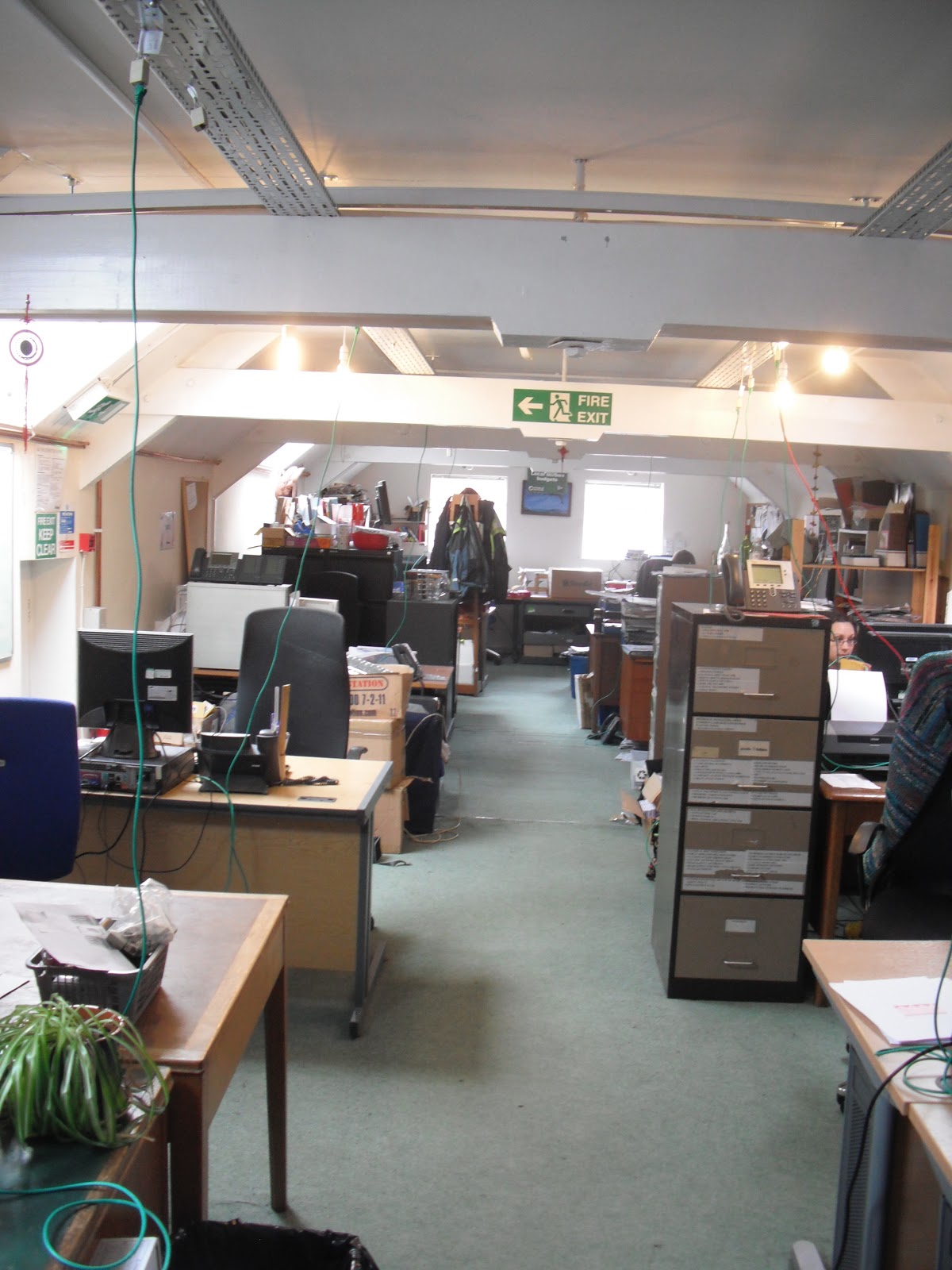
Finally, a sneaky preview of the main office, more photos and introductions to follow next time...
Of all the feats of geek culture, the one which most consistently surprises and intrigues me is its ability to twist the writings of HP Lovecraft (1890 - 1937) into novelty shapes. And sometimes even make money from it.
That's Lovecraft, the writer of horror and weird fantasy whose protagonists generally mutate, go mad, die or some noxious combination of the three; Lovecraft, the misanthrope and holder of some unsavory views about non-white races which ought to severely test the Wagner Defence for any fan; Lovecraft, man of a thousand hysterical adjectives, usually loathsome, hideous and blasphemous. The Lovecraft, who in spite of all of the above wrote a small number - I stress the word small - of truly great short stories in which he dialed down his nervous tics and channelled his talents into saying just this: that what humanity laughably terms normality, knowledge, civilisation are candles in a universe far larger and darker than we can ever know.
The Lovecraft, whose for-want-of-a-better-term brand ambassador is a titanic giant with an octopoid head sleeping beneath the waves awaiting a time in which he will (consults notes) ah yes, lead humanity in a Nietzschean power-trip culminating in species-death. Or something to that effect.
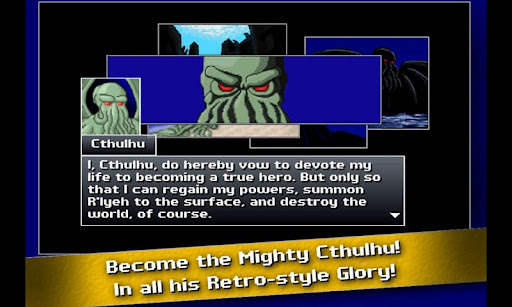
Yet fans, geeks and gamers go mad for cutesy extrapolations of the Lovecraft mythos. And Cthulhu seems to have become the focus for this attention. Not bad for a slimy, squamous bringer of armageddon.
At the commerical end of the spectrum, take this plush example, courtesy of the Geekest Link.
Or, from tabletop gaming, Munchkin Cthulhu, from where this free downloadable card originates.
But let's not forget what the fans do purely for the love, like this Adventures of L'il Cthulhu animation
Or pushing the boat out still further, Lovecraftian webcomics, Lolthulu, and Cthulhu Mythos Christmas jingles (clip below).
You can find more examples of Cthulhukitsch in a Guardian article I swear I haven't read. But my question is not: should I join in by attempting to rewrite the theme tune to the Mickey Mouse Club among Lovecraftian lines (and I assure you, you can fit C-T-H-U-L-H-U F-T-H-A-G-N in there). Rather, it's why? Why has Cthulhu become the cosmic threat beyond space and time it's ok to like?
I've got two possible answers to run up the flagpole here. One, while Lovecraft wouldn't have known how to promote his work if it was carved in prehistoric runes on a mysterious monolith thirty foot high, he did have extraordinarily savvy (culturally if not commercially) posthumous champions. Right from his death in the 1930's, supporters like August Derleth founded Arkham House to ensure his work, never properly published outside of pulp magazines in his lifetime, was properly and respectfully released.
Authors since then have written further works in the Lovecraftian universe, or at least in his idiom, further extending its tentacular reach through fandom. Further amplified by the Call of Cthulhu role-playing game and works in other media (see examples above, but also Metallica songs, Re-animator movies etc) HP has grown to the point where - beyond the grave - he is an undisputed big deal.
Yet the Lovecraft legacy has been distorted over the years such that he has become to wierd fiction what Elvis is to rock and roll. You don't need to listen to Elvis to go to Graceland, talk about jelly bean sandwiches or invoke the rhinestone jump suit. Similarly, you don't need to read Lovecraft in geek culture to roll off - and crucially parody - the list of tropes he's associated with: madness; cultists; forbidden knowledge; tentacles; indescribable horror; the Necronomicon, the word 'squamous'.
I didn't read much of his work until my thirties and I still could have told you all about him, after having put both hands to my chin and waved my fingers in a tentacular fashion. In other words, pop culture Lovecraft (as opposed to Lovecraft the writer) is ripe for commodification, homage and satire. And yet there's a second possibility here - that at his best (say, The Whisperer in Darkness or The Shadow Over Innsmouth), there is something sufficiently disturbing and original still in Lovecraft that the urge to camp him up, to ironically enjoy him, to consume plush offshoots of his work, is a defence mechanism.
We laugh at his obsessions - and boy is it easy to laugh at him - because if we go back to the books and allow him to draw us in then he still, as an outsider artist with a singular vision, has the power to unnerve, to ask what lies beyond the reach of our candle in the darkness.
The most merciful thing in the world, I think, is the inability of the human mind to correlate all
its contents. We live on a placid island of ignorance in the midst of black seas of infinity,
and it was not meant that we should voyage far. The sciences, each straining in its own
direction, have hitherto harmed us little; but some day the piecing together of dissociated
knowledge will open up such terrifying vistas of reality, and of our frightful position therein,
that we shall either go mad from the revelation or flee from the deadly light into the peace and
safety of a new dark age.