Flaws of the First Chronicles
I wouldn't be referring to Covenant as a failure all this time if I didn't ultimately see it as a missed opportunity. Despite my admiration for the Chronicles as an attempt at a ethical project, a world-building exercise and a subversion of high fantasy, it's undone at the same time by some serious weaknesses.
Most of the Covenant-mocking I've seen starts with his use of language - it's the kind of book where both the characters and the narrator drop in words like 'inexculpable' and 'anneal' as casually as they can - which is to say not very. But I've read Poe, I've read Lovecraft. I can take this. And least Donaldson's trying to be creative with his clunkiness in a rather charming way.
The poetry is universally bad, however. This is one bit of Tolkien I wish he hadn't imitated.
But I have bigger fish to fry with my critical Earthpower (Critpower?).
Protagonist problems
Covenant is meant to be a troubled character - embittered, suffering from an incurable disease, and stunned by the health and truth of The Land. Donaldson loads his back-story - I think - with enough woe to make his dilemma believable.
But Donaldson has Covenant do something upon arrival in The Land in Lord Foul's Bane to further complicate his relationship with the fantasy and purposely alienate the reader. Covenant rapes the young woman, Lena, who welcomes him to her village.
It's as shocking in print as it is in bare summary here. If the Amazon reviews are anything to go by, this kills the book outright for many readers.
To be fair to the author, he doesn't let Covenant off the hook for this. Not only could the first half of LFB be subtitled Self-laceration against a fantasy backdrop, but over the course of the three books Covenant gradually reaps the terrible consequences of his action.
But by destroying any empathy you might feel for the central character, the crime reduces the impact of the central question of the Chronicles: is an illusion worth fighting for? Instead, you get the pop reduction of Covenant to asshole leper hero.
It doesn't help the book, and it doesn't help Donaldson's problems with women in his novels either.
Why you thought this was a good idea I really do not know
The Chronicles actually have a lot of strong women - warriors, Lords, village elders - but when I sat down and thought about it the safest place for a female character to be in Stephen Donaldson's fiction is in the second rank. That way you get to be awesome without stepping into the authorial line of fire.
Let's take a look at the main female characters in Covenant and what happens to them, shall we?
Lena - rape and murder (the second not by Covenant)
Atiaran (Lena's mother) - despair and death by magical accident
Elena (Lena and Covenant's daughter) - killed by a ghost and brought back from the dead so she can be degraded and killed again.
Now that I think of it, pretty much every one of Donaldson's leading women in his other novels gets thrown in a dungeon and tortured - sometimes sexually - at some point or other. None of it is written to titilate, but if he's trying to make a serious point it's eluding me too.
But that's even before we get to the crowning WTF moment of the entire series on book 2, the Illearth War: Back in the Land after weeks of his time and years of their time, Covenant encourages his daughter Elena's sexual overtures to him so she - now a Lord and super-jedi - can take on the role of saviour of The Land and let him off the hook.
????????????
And for good measure
%$&#£@^*&*!
!!!!!!!!!!!!!!!!!!!!
I can guarantee you that no-one who gets this far into the trilogy is wondering if Covenant will reconcile his disbelief in The Land with the need to act to protect it. They are all - all of them, darn it - thinking "Dude! This is wrong on so many levels my head hurts"
And these flaws are too big for the reader to ignore.
In writing these reflections, I've discovered that I like the idea of Covenant better than I do the reality. Much as I might appreciate what Donaldson tried to do, as all the bits in The Illearth War and The Power That Preserves without Covenant are great, as the trilogy fizzes intermittently with great ideas, he undermines his own foundations with narrative decisions which seem designed to alienate the reader and cause me to question the merit of the entire project.
Saturday, December 31, 2011

Wednesday, December 28, 2011
The most important failure in modern fantasy fiction Pt 3
Digression - towards a progressive idea of fantasy fiction
The politics of high fantasy - in as far as it articulates them - are deeply retrogressive. While neither Tolkien nor C S Lewis can be simply filed as political conservatives, their works and the works of those who followed them in creating the mainstream of modern fantasy are problematic for the progressive reader.
This is because they fetishise an imaginary medieval.
Humour me while I set up a straw man in high fantasy clothing here. A mediocre author writing in the genre will give you uncritical adulation of monarchy and aristocracy, a poor-but-happy peasantry, nations and species defined by a single characteristic (grumpy dwarf syndrome), fantasy racism (dead orcs don't count), orientalism, patriachy-a-go-go and obfuscatory mysticism.
The classic fantasy happy ending is one which validates any or all of this above. Preferably through a prophecy.
The fact that your setting is pre-modern is not an excuse for any of this if you're making it up.
Good authors can, will and often do subvert these cliches - but in my view most interesting fantasy is being written outside of the genre (wierd fiction, magic realism, science fantasy) precisely because of this millstone.
I don't ask for a politically correct re-imagining of the past, or for Conan to be sent on sensitivity training, but seriously, fantasy writers, the clue is in the name of genre you're writing in.
What does this have to do with Thomas fricking Covenant?
In this context Covenant is interesting because the society he encounters manages to avoid most of the pitfalls I've just outlined.
The people of The Land live mainly in self-governing villages without a trace of a medieval hierarchy. There is no king - there are Lords, but lordship is achieved through initiation into arcane knowledge, training in which is open to all. Men and women alike play leading roles in the villages, the lore-keepers and the military.
Grumpy dwarf syndrome does rear its ugly head with the giants, and fantasy racism with the ur-viles and cavewights existing mainly for plot purposes as sword fodder. But at least the Tolkien xeroxing is kept to a minimum (there are no elves, Galadriel be thanked).
None of the usual grab-bag of forelock-tugging, old-time religion and oppression which usually holds you-haven't-this-through fantasy societies applies in The Land. Instead Donaldson gives us a picture of a people held together by reverence for all that is living, sworn to the healing and protection of the earth.
Whole communities dedicate themselves to the care and mastery of earth and stone, plant and tree, or horses. Other than protecting the Land and increasing their knowledge of 'Earthpower', the Lords pride themselves in their restoration of areas once blighted by Lord Foul.
How many fantasy societies can you think of where everyone swears an oath of peace?
This wierd cocktail of agrarian anarchism, deep ecology and benign academia is there in plot terms, like the geography of The Land, to heighten Covenant's dilemma, to be 'too good' for him. As we shall see, one of the hallmarks of the people of the Land is their refusal to punish him for his misdemeanors (more of which in part 4).
But it also takes us away from the kind of half-baked medievalism of high fantasy into something more like the utopianism which used to be part of fantasy (Cockayne, Shangri-La) before it became the preserve of science fiction and political theory.
The utopian strain running through Covenant is a worthy attempt to use fantasy to put forward some downright progressive ideas about man's relationship to man and nature.
And it's a utopia which had a powerful influence on at least one 90's teenager. When asked, I tell people that the two things which got me into environmentalism were hearing about the greenhouse effect (yes, I really am that old) and reading Covenant and understanding what a reverence for nature and for the achievements of your ancestors could mean in practice.
The politics of high fantasy - in as far as it articulates them - are deeply retrogressive. While neither Tolkien nor C S Lewis can be simply filed as political conservatives, their works and the works of those who followed them in creating the mainstream of modern fantasy are problematic for the progressive reader.
This is because they fetishise an imaginary medieval.
Humour me while I set up a straw man in high fantasy clothing here. A mediocre author writing in the genre will give you uncritical adulation of monarchy and aristocracy, a poor-but-happy peasantry, nations and species defined by a single characteristic (grumpy dwarf syndrome), fantasy racism (dead orcs don't count), orientalism, patriachy-a-go-go and obfuscatory mysticism.
The classic fantasy happy ending is one which validates any or all of this above. Preferably through a prophecy.
The fact that your setting is pre-modern is not an excuse for any of this if you're making it up.
Good authors can, will and often do subvert these cliches - but in my view most interesting fantasy is being written outside of the genre (wierd fiction, magic realism, science fantasy) precisely because of this millstone.
I don't ask for a politically correct re-imagining of the past, or for Conan to be sent on sensitivity training, but seriously, fantasy writers, the clue is in the name of genre you're writing in.
What does this have to do with Thomas fricking Covenant?
In this context Covenant is interesting because the society he encounters manages to avoid most of the pitfalls I've just outlined.
The people of The Land live mainly in self-governing villages without a trace of a medieval hierarchy. There is no king - there are Lords, but lordship is achieved through initiation into arcane knowledge, training in which is open to all. Men and women alike play leading roles in the villages, the lore-keepers and the military.
Grumpy dwarf syndrome does rear its ugly head with the giants, and fantasy racism with the ur-viles and cavewights existing mainly for plot purposes as sword fodder. But at least the Tolkien xeroxing is kept to a minimum (there are no elves, Galadriel be thanked).
None of the usual grab-bag of forelock-tugging, old-time religion and oppression which usually holds you-haven't-this-through fantasy societies applies in The Land. Instead Donaldson gives us a picture of a people held together by reverence for all that is living, sworn to the healing and protection of the earth.
Whole communities dedicate themselves to the care and mastery of earth and stone, plant and tree, or horses. Other than protecting the Land and increasing their knowledge of 'Earthpower', the Lords pride themselves in their restoration of areas once blighted by Lord Foul.
How many fantasy societies can you think of where everyone swears an oath of peace?
This wierd cocktail of agrarian anarchism, deep ecology and benign academia is there in plot terms, like the geography of The Land, to heighten Covenant's dilemma, to be 'too good' for him. As we shall see, one of the hallmarks of the people of the Land is their refusal to punish him for his misdemeanors (more of which in part 4).
But it also takes us away from the kind of half-baked medievalism of high fantasy into something more like the utopianism which used to be part of fantasy (Cockayne, Shangri-La) before it became the preserve of science fiction and political theory.
The utopian strain running through Covenant is a worthy attempt to use fantasy to put forward some downright progressive ideas about man's relationship to man and nature.
And it's a utopia which had a powerful influence on at least one 90's teenager. When asked, I tell people that the two things which got me into environmentalism were hearing about the greenhouse effect (yes, I really am that old) and reading Covenant and understanding what a reverence for nature and for the achievements of your ancestors could mean in practice.
Tuesday, December 27, 2011
The most important failure in modern fantasy fiction Pt 2
Psycho-geography
Like most fantasy writers, Donaldson's world-building is shaped by plot expediency and sheer joy in topography and taxonomy. However, that The Land also reflects and partakes in Covenant's psychodrama is a masterstroke

At the start of two of the three books in the Chronicles, Covenant is forced to descend the look out tower of Kevin's Watch. This descent is as much spiritual as physical; it marks his exit from modernity and its entry into a realm begging him to make an apparently simple moral choice to defend it.
Sometimes this plea is verbal, often it is shown rather than told through the beauty of the landscape Covenant sees on his wandering: the Andelainian hills; the pure pool of Glimmermere; the Petra-a-like city of Revelstone. It is even embodied by the 'highest' and 'best' inhabitants of The Land, such as the Giants or the Ranyhyn horse-lords.
In order for Covenant's dilemma to have meaning, this geographical hyperbole is essential. It is vital that The Land be 'too good' for him, ask too much of him.
The creation of The Land through the visual imagination of Stephen Donaldson transcends window dressing - it becomes - and I mean this as a serious compliment - it becomes a stage set which enhances the meaning of the tale itself.
Like most fantasy writers, Donaldson's world-building is shaped by plot expediency and sheer joy in topography and taxonomy. However, that The Land also reflects and partakes in Covenant's psychodrama is a masterstroke
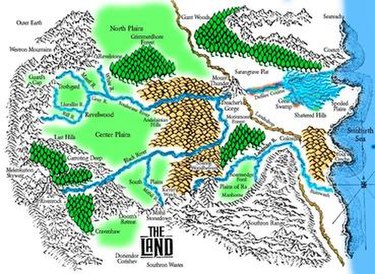
At the start of two of the three books in the Chronicles, Covenant is forced to descend the look out tower of Kevin's Watch. This descent is as much spiritual as physical; it marks his exit from modernity and its entry into a realm begging him to make an apparently simple moral choice to defend it.
Sometimes this plea is verbal, often it is shown rather than told through the beauty of the landscape Covenant sees on his wandering: the Andelainian hills; the pure pool of Glimmermere; the Petra-a-like city of Revelstone. It is even embodied by the 'highest' and 'best' inhabitants of The Land, such as the Giants or the Ranyhyn horse-lords.
In order for Covenant's dilemma to have meaning, this geographical hyperbole is essential. It is vital that The Land be 'too good' for him, ask too much of him.
The creation of The Land through the visual imagination of Stephen Donaldson transcends window dressing - it becomes - and I mean this as a serious compliment - it becomes a stage set which enhances the meaning of the tale itself.
Saturday, December 24, 2011
The most important failure in modern fantasy fiction Pt 1
Yes, as part of my attempt to reboot my reading habits by going back to the old school, I've tackled the First Thomas Covenant trilogy by Stephen Donaldson. This is part one of a four page sanity-preserving peace I'll be writing over the Christmas break. :-)
Warning: this is more reflection than review - but here nonetheless be massive spoilers.
For a proper plot synopsis, see the Wikipedia articles for:
I have the impression - rightly or wrongly - that the Covenant books are something of a Marmite proposition for fantasy fans. For some, they seem to inspire the kind of intense love you can witness at the Kevin's Watch discussion board. For others, the flaws in the series prove impossible to overlook.
But let's start with why Covenant still matters to anyone who takes fantasy fiction seriously.
"Comparable to Tolkien at his best"
The editions of the First Chronicles I cut my teeth on came with this millstone of a quote. In the best traditions of back cover blather, it is, inevitably, completely right and utterly wrong at the same time.
Covenant is many things, but it's most obviously a subversion (and sometimes a celebration) of the clichés of high fantasy which had grown up in the decades post Lord of the Rings. Quests miscarry their purpose. Magic McGuffins lare turned against their users. Sometimes the cavalry doesn't arrive in time.
In particular, the Chronicles takes aim at the John Carter power-trip in fantasy fiction. The all-too-common plot of a modern man finding himself (literally and metaphorically) in a fantasy world, becoming the champion of light against the dark, victorious and loved, is adolescent wish-fulfilment in print. A book has to be very good these days for me to tolerate this trope.
In contrast, Thomas Covenant is a very reluctant champion for the land (named, with endearing/infuriating literalness, The Land) to which he finds himself transported. A grieving writer suffering from leprosy, with intense distrust of himself and others, who has no desire to be the prophesied saviour of another world he barely believes in, Covenant retains his complex modernity in a world of apparently simple moral choices.
To an extent unique in fantasy, Donaldson is concerned with ethics and the problem of acting rightly and is using the Chronicles as a vehicle for exploring his views. Where the comparison with Tolkien holds true is that they are both deadly serious about their respective literary projects.
In the Chronicles Covenant is presented with a very Buddhist or existentialist conundrum: is an illusory but oh-so-seductive world something worth fighting for or a threat to one's integrity as an individual?
Time and time again, the supporting characters of Good - the Lords (think less feudal barons, more medieval Jedi) of the Land and their allies either ask him for aid or present him with yet more evidence of the beauty and virtue of the world to which he has been summoned.
This weight of prophetic expectation is doubled by the 'fact' that Covenant is walking around with the fantasy equivalent of the Pershing missile on his hand - his white gold wedding ring - and has no idea how to use it.
Everything he can do is overwhelmed by its potential significance and his potential responsibility for the Land and the lives of those who live in it.
“And he who wields white, wild magic gold is a paradox For he is everything and nothing Hero and fool Potent, helpless And with one word of truth or treachery He will save or damn the earth Because he is mad and sane Cold and passionate Lost and found”
At this stage in his writing career, Donaldson's prose poetry varies wildly, but I like to think that Albert Camus would approve of this statement of Covenant's potential.
Another recurring factor here is the insistence in The Chronicles - again, rendolent of Buddhist thought - that we are undone by our passions, however noble. The supporting characters in the trilogy may have simplistic motivations in the tradition of heroic fantasy - loyalty to the cause of good, love of nature, pride in service. But Donaldson makes the point - repeatedly - that the extravagance of their virtue leads them into defeat and turns their own best weapons against them.
Got warrior monks (the Bloodguard) in the service of the Land who draw power from their unbroken vow for example? Then have the big bad (a largely shapeless force of corruption rejoicing in the name of Lord Foul) cause them to break their vow and dissolve their order. Simples.
In a situation of such moral hazard, can Covenant be blamed for his caution?
Coming up later in the Christmas break
- Part 2 - Psycho-geography
- Part 2 - Psycho-geography
- Part 3 - Towards a progressive idea of fantasy
- Part 4 - The Many Flaws of the First Chronicles
Tuesday, November 22, 2011
Review: Lord of Light, Roger Zelazny
Recently, I've had a block about reading anything longer than a magazine. This is highly unusual for me - given that my whole life has been defined, pretty much, by books.
Only an oral history of 70's punk has slipped through in the last month, and given that this mainly consisted of bitchy anecdotes about Tom Verlaine, I'm not sure this really counts.
So, in mild desperation, I've gone back to the old school to hit the classic SF and fantasy works on my shelves (note plurality of books and shelves), returning to my gateway drug.
Lord of Light takes up Arthur C Clarke's maxim that any sufficiently advanced science is indistinguishable from magic. It runs with it all the way to a colony world in the distant future, where those who have the technology have set themselves up as gods mimicking the Hindu pantheon to 'guide' the medieval majority. As is traditional in myth and science fiction, one man challenges the status quo and takes on the Promethean role of bringing science to the masses.
Yes, there are climactic battles, yes, sh*t is blown up in Bay-vian proportions. But what makes Lord of Light (LoL? LOL!) interesting is that the most potent action the hero takes is to counter the hierarchical, false Hinduism of his adversaries by taking on the role of Buddha. A faith with strong egalitarian and atheistic tendencies, Buddhism acts in LoL as prerequisite and smokescreen for reintroducing scientific curiosity.
Zelazny's sincere engagement with both religions gives the novel a curiously philosophical quality, where a character's attitude towards death and reincarnation is given as much air time as his actions. At several points, the main characters stop for some serious sermonising and chin-stroking and it's a tribute to the quality of the writing that these serve to enhance the power and atmosphere of the story rather than quicksanding it.
The climactic battle, on the other hand,, is over in less than less than four pages. Zelazny, you are the anti-Gemmell.
But it's the writing, with its rich characterisation and elegant detours into a remixed Indian culture,
which helps to rescue LoL from merely being Orientalism at play. While this is still a potential major weak-point in the novel, by hinting at the white origins of the so-called gods artificially recreating medieval India, it arguably includes its own self-critique.
And for those less inclined to read between the lines, the only overtly white character is a crypto-fascist (thanks, Lister) necromantic Christian evangelist!
More clearly on the debit side, the main female characters are, respectively, a praying mantis and a passive victim. And before starting, you have to acknowledge that Z's take on Hinduism has everything to do with the myths and nothing to do with contemporary spiritual practice.
Lord of Light isn't an important book, or a great one, for all that it won a Hugo back in its day.('71). But it's still an extremely good planetary romance with frequent chin-stroking and occasional flurries of action.
Only an oral history of 70's punk has slipped through in the last month, and given that this mainly consisted of bitchy anecdotes about Tom Verlaine, I'm not sure this really counts.
So, in mild desperation, I've gone back to the old school to hit the classic SF and fantasy works on my shelves (note plurality of books and shelves), returning to my gateway drug.
Lord of Light takes up Arthur C Clarke's maxim that any sufficiently advanced science is indistinguishable from magic. It runs with it all the way to a colony world in the distant future, where those who have the technology have set themselves up as gods mimicking the Hindu pantheon to 'guide' the medieval majority. As is traditional in myth and science fiction, one man challenges the status quo and takes on the Promethean role of bringing science to the masses.
Yes, there are climactic battles, yes, sh*t is blown up in Bay-vian proportions. But what makes Lord of Light (LoL? LOL!) interesting is that the most potent action the hero takes is to counter the hierarchical, false Hinduism of his adversaries by taking on the role of Buddha. A faith with strong egalitarian and atheistic tendencies, Buddhism acts in LoL as prerequisite and smokescreen for reintroducing scientific curiosity.
Zelazny's sincere engagement with both religions gives the novel a curiously philosophical quality, where a character's attitude towards death and reincarnation is given as much air time as his actions. At several points, the main characters stop for some serious sermonising and chin-stroking and it's a tribute to the quality of the writing that these serve to enhance the power and atmosphere of the story rather than quicksanding it.
The climactic battle, on the other hand,, is over in less than less than four pages. Zelazny, you are the anti-Gemmell.
But it's the writing, with its rich characterisation and elegant detours into a remixed Indian culture,
which helps to rescue LoL from merely being Orientalism at play. While this is still a potential major weak-point in the novel, by hinting at the white origins of the so-called gods artificially recreating medieval India, it arguably includes its own self-critique.
And for those less inclined to read between the lines, the only overtly white character is a crypto-fascist (thanks, Lister) necromantic Christian evangelist!
More clearly on the debit side, the main female characters are, respectively, a praying mantis and a passive victim. And before starting, you have to acknowledge that Z's take on Hinduism has everything to do with the myths and nothing to do with contemporary spiritual practice.
Lord of Light isn't an important book, or a great one, for all that it won a Hugo back in its day.('71). But it's still an extremely good planetary romance with frequent chin-stroking and occasional flurries of action.
Sunday, November 13, 2011
Best of the blogs
Polemic of the week - Wind of change
Fascinating reading from pro-wind campaigner Aeolius in Worcestershire who's had to face particularly vociferous opposition locally, it seems. Not sure about his use of the term mentalist, but otherwise boldly goes forth and meets the anti crowd on their own terms.
Common sense widget of the week - Fix Before The Freeze from polihackers (i.e. they use IT to create short cuts through the political undergrowth) My Society.
Winter is coming, and not in a Sean Bean kinda sense.
"You may already be aware of our website FixMyStreet.com, which helps you report common street problems – such as potholes and uneven pavements – to the relevant local council. This year, we thought we’d give people a gentle nudge before winter comes.
Many of the 1,000 issues which the site deals with every week are of the sort which are far better seen to before the big freeze. Potholes only worsen with the frost, and no-one wants a dodgy streetlight once the long dark nights are here."
Common sense made easy - especially for those of us with impractical shoes.
Geek out of the week - Monsters & Mullets
Because what you really want are detailed assessments of Willow, Krull and Robin Hood: Prince of Thieves from a 21st century perspective. And a deconstruction of the sexual politics of Flash Gordon.
Don't be put off by the fact that this feature operates out of a blog called Pornokitsch - it's generally SFW. Except the review of Caligula, but I'm not sure if a SFW review of Caligula would be possible without the universe imploding.
Tuesday, November 8, 2011
Game outline - The End of History - players sought
The storytelling bug has hit me again, so I'm going to be running a small role-playing game for the first time in at least five years, using the Aberrant superhero rules and universe to run something closer in spirit to The X-Files and Watchmen, with a sprinkle of Bourne.
3 or 4 players sought - no experience needed - so just apply to me. :-)
Here's my three paragraph teaser for The End of History (a Fukuyama quote, not a promise of armageddon).
 1989 - Eastern Europe is crumbling into revolution. Uncertain times for cold war warriors, four-star generals and CIA stringers.
Uneasy times too for the human element of the arms race, those hyper-rare caped champions of communism and capitalism, totems of patriotism and struggle.
But not for your agency. The human and posthuman agents of The Directive know that glasnost has opened up plenty of Eastern Bloc messes to clear up from the shadows. Soviet wierd science; the supernatural; renegade Stasi agents with powers and hidden agendas.
Never mind the our work-is-never-done investigation, regulation and occasional regulation with extreme prejudice of the Powered in the West.
Whether your character volunteered or was given one of The Directive's infamous 'join us or go to Area 51' ultimatums, it's time to see those uneasy, interesting times for yourself.
3 or 4 players sought - no experience needed - so just apply to me. :-)
Here's my three paragraph teaser for The End of History (a Fukuyama quote, not a promise of armageddon).
 1989 - Eastern Europe is crumbling into revolution. Uncertain times for cold war warriors, four-star generals and CIA stringers.
Uneasy times too for the human element of the arms race, those hyper-rare caped champions of communism and capitalism, totems of patriotism and struggle.
But not for your agency. The human and posthuman agents of The Directive know that glasnost has opened up plenty of Eastern Bloc messes to clear up from the shadows. Soviet wierd science; the supernatural; renegade Stasi agents with powers and hidden agendas.
Never mind the our work-is-never-done investigation, regulation and occasional regulation with extreme prejudice of the Powered in the West.
Whether your character volunteered or was given one of The Directive's infamous 'join us or go to Area 51' ultimatums, it's time to see those uneasy, interesting times for yourself.
Subscribe to:
Posts (Atom)